
Some abbreviations make you smile. KMT makes you wince a little. If you have ever received these three letters out of nowhere and felt a tiny wave of guilt wash over you, there is a good reason. KMT is not cute, flirty, or playful. It is a full attitude packed into one short word.
This guide covers the KMT meaning in text, the Caribbean gesture behind it, how it traveled to UK chats and then to screens everywhere, what it sounds like on each app, real examples, and exactly how to reply when someone sends it your way.
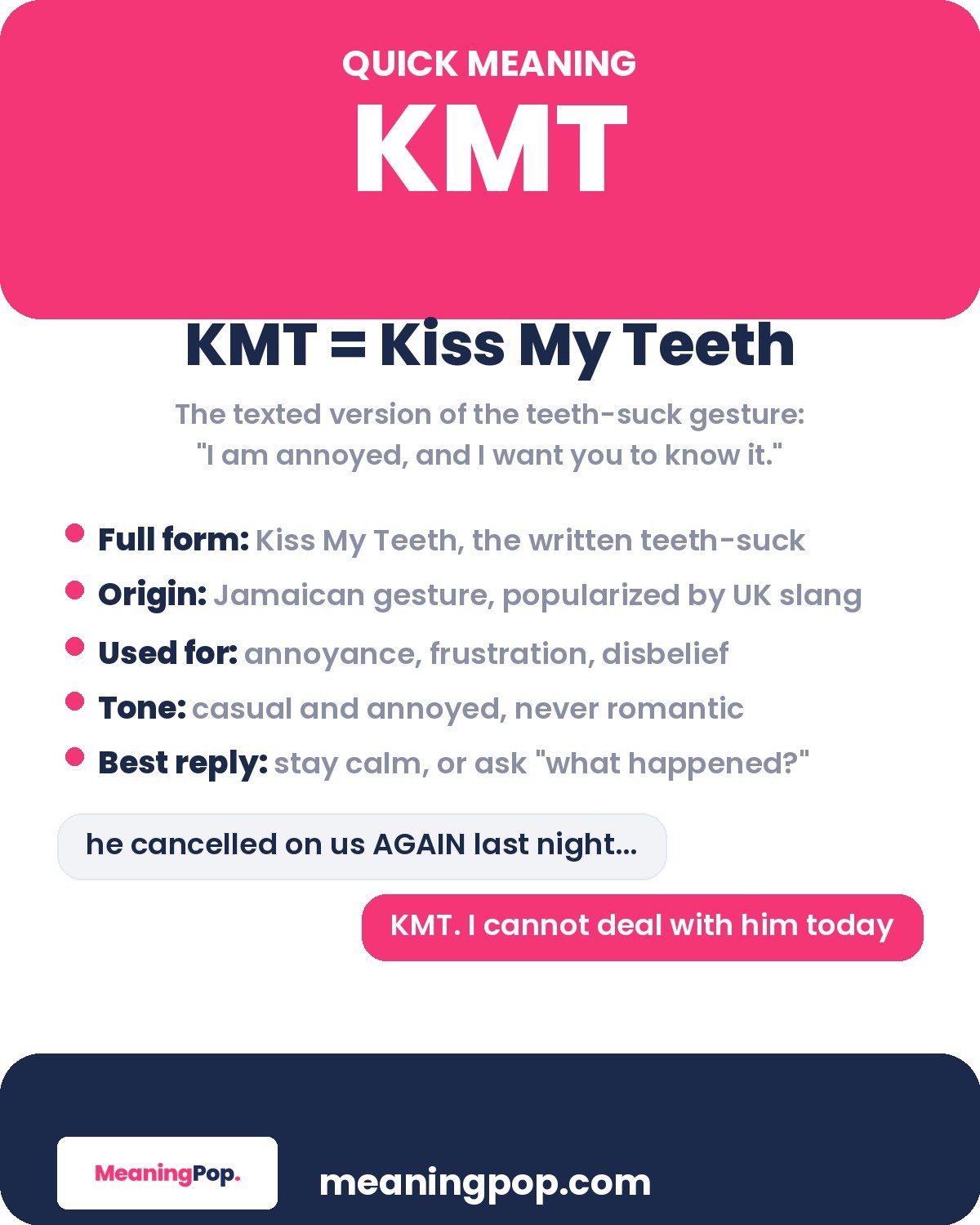
Quick Answer: KMT means “Kiss My Teeth.” It is the written version of the sharp teeth-sucking sound people make to show annoyance, frustration, disbelief, or disapproval. The KMT meaning in text is basically a digital eye roll. It is not romantic, and it is never used in formal writing.
Table of Contents
What Does KMT Mean in Text?
In texting, KMT stands for “Kiss My Teeth.” It recreates the sound of someone sucking their teeth, that short, sharp “tssk” that people make when something annoys them. The KMT meaning in text is therefore emotional, not literal. Nobody is asking you to kiss anything. The sender is telling you, “I am annoyed, and I want you to know it.”
This matters because KMT carries real attitude. Unlike playful slang such as IYK or LOL, KMT almost always signals that the sender is irritated. It can be aimed at a person, a situation, a piece of news, or just life in general. The feeling behind it is the same one you get when someone sighs loudly across the room. Now that sigh has a spelling.
Definition: KMT (Kiss My Teeth) is an informal texting abbreviation that writes out the teeth-sucking sound of annoyance. It expresses frustration, disbelief, impatience, or disapproval, and it comes from a Caribbean gesture that traveled into UK slang before spreading online.
People usually send KMT when they want to:
- Show they are fed up with a person or a repeated situation
- React to bad news without typing a long reply
- Express disbelief at something ridiculous or unfair
- Signal playful annoyance between close friends who roast each other
So if a friend cancels plans for the third time and you reply “KMT.”, the message is complete. No paragraph is needed. Everyone who knows the word can hear the teeth-suck, feel the eye roll, and understand exactly where you stand.
Where Did KMT Come From?
The story of KMT starts long before smartphones. The teeth-suck, also called teeth-kissing, is a well known gesture across Jamaica and the Caribbean. People press the tongue against the back of the teeth and pull in air sharply, producing a loud “tssk” or “kssst” sound. It is a wordless way of saying “I am not happy about this,” and it can carry anything from mild irritation to open contempt.
The gesture traveled with Caribbean communities to the United Kingdom, where it became a signature sound of UK slang culture. In British cities, the teeth-suck is so common that it is practically punctuation in everyday speech. From there it was a short step to typing it. Wikipedia documents the teeth-sucking gesture and its roots in Afro-Caribbean communication, which helps explain why the typed version feels so natural to millions of people.
UK music, UK drill, and British internet culture then carried the abbreviation far beyond London. Once young people in one country started dropping KMT in group chats, memes, and comment sections, the letters went global. Today you can see KMT in chats in places where nobody has ever heard the actual teeth-suck sound. The letters alone do the work.
Writers who study how slang evolves online have noted how typed reactions like this one compress a whole sound, gesture, and emotion into a few letters. A piece on modern slang from Language and Innovation explores how new expressions spread and mutate on the internet, which is exactly the path KMT took from Caribbean streets to British phones to group chats everywhere.
What KMT Means in Different Contexts
KMT always carries annoyance, but the flavor of that annoyance changes with context. Reading it correctly depends on who sent it and what is happening around it.
- Mild frustration: A friend is venting about traffic, and you send KMT. This means “that is so annoying,” aimed at the situation, not at them.
- Disbelief: Someone tells you an unbelievable story, and KMT means “I cannot believe that just happened.”
- Impatience: A reply that never comes, a plan that keeps changing, and KMT says “hurry up, this is getting old.”
- Disapproval: Aimed directly at a person, KMT can be sharp. It says “you are wrong, and I am judging you for it.”
- Playful roasting: Between close friends, KMT can be affectionate teasing. The words sting, but both people are laughing.
The golden rule: KMT is almost never neutral. If you receive it, something about the situation has tested the sender’s patience. The kindest reading is “I am annoyed at the situation.” The sharpest reading is “I am annoyed at you.” Your reply should match which one it is.
KMT Meaning on Different Social Media Platforms
The letters stay the same everywhere, but each app gives KMT a slightly different stage. Here is how the KMT meaning in text shifts from platform to platform.
On WhatsApp
On WhatsApp, KMT shows up in private chats and family groups, usually as a quick reaction to news. An aunt sends KMT when the family group shares a price increase. A friend sends KMT when someone is late again. It is direct, personal, and often aimed at the person reading it.
On Instagram
On Instagram, KMT appears in comments, captions, and story replies. It is a public performance of annoyance. Someone posts a ridiculous take, and the comments fill with KMT. Creators sometimes use it on themselves too, captioning a failed video with KMT as a joke about their own bad luck.
On TikTok
On TikTok, KMT lives in comments and on-screen text under relatable videos. A video about dating red flags, bad bosses, or pointless rules collects hundreds of KMT comments. Here it works like applause for the video’s frustration, everyone agreeing at once that the situation is unacceptable.
On Snapchat
On Snapchat, KMT rides on quick snaps and private replies between close friends. A photo of a long queue, a cancelled plan, or a messy room gets a KMT reply in seconds. It fits the app’s fast, in the moment style, one reaction and the moment is over.
On X (Twitter) and Reddit
On X and Reddit, KMT is a public judgment. Under a controversial post, KMT signals disapproval without starting a full argument. It is shorter than a reply, sharper than a downvote, and everyone in UK slang circles understands it instantly.

Real Examples of KMT in Text
The fastest way to learn the KMT meaning in text is to watch it work. Each example below comes with the situation behind it.
Zara: He said the meeting is moved to Sunday again
Dan: KMT. I already cancelled my weekend plans once
Zara: Right? I am actually done being polite about it
Notice how KMT replaces a whole paragraph of complaining. Dan’s frustration is clear in three letters, and Zara instantly understands the mood.
- Example 1: “The bus drove past me again. KMT.”
Annoyance at bad luck, aimed at the situation, not at any person. - Example 2: “KMT, she still has not replied to my message.”
Impatience directed at a specific person who is ignoring the sender. - Example 3: “Rent went up AGAIN this year. KMT.”
Frustration at an unfair situation, shared to invite agreement. - Example 4: “You ate the last slice? KMT.”
Playful annoyance between friends or siblings, usually followed by laughter. - Example 5: “He said he never got the email. KMT, I sent it twice.”
Disbelief mixed with irritation, calling out an obvious excuse. - Example 6: “KMT. My phone died right before the interview call.”
A reaction to personal bad luck, venting into the chat. - Example 7: “Another group project where I do everything. KMT.”
Resentment about unfair work, looking for sympathy. - Example 8: “They changed the deadline without telling anyone. KMT.”
Disapproval aimed at whoever made the decision.

KMT vs SMH vs BRUH vs TSK: What Is the Difference?
The kmt meaning in text has close relatives in texting slang. They all express some version of “I cannot believe this,” but each one has its own temperature. Here is how they compare.
| Term | Stands For | Feeling | Strength |
|---|---|---|---|
| KMT | Kiss My Teeth | Annoyed, fed up, judging | Strong. Real irritation behind it |
| SMH | Shaking My Head | Disappointed, unimpressed | Medium. Sad more than angry |
| BRUH | Bro (exclamation) | Stunned, amused disbelief | Light. Often funny, rarely mean |
| TSK | The teeth-suck sound itself | Mild annoyance, tutting | Strong. A softer, older cousin of KMT |
A simple rule of thumb: use BRUH for funny disbelief, SMH for disappointment, TSK for a mild tut, and KMT when you are genuinely annoyed. Getting the temperature right keeps your replies from sounding harsher, or softer, than you intended.
How to Respond When Someone Sends You KMT
Your reply depends on one thing: who the KMT is aimed at. If it is aimed at the situation, join in. If it is aimed at you, stay calm.
If KMT Is Aimed at the Situation
- “I know right? It is actually ridiculous.” Agree and validate. This is the safest reply.
- “KMT indeed. What are we going to do about it?” Send KMT back to show you feel the same, then move toward a solution.
- “Haha, deep breaths. Tell me everything.” Lighten the mood and invite them to vent.
If KMT Is Aimed at You
- “Fair. I messed up, sorry.” If you are in the wrong, own it. This defuses KMT instantly.
- “Okay okay, what did I do? Talk to me.” Ask for the real issue instead of guessing.
- “Wow, tell me how you really feel.” Playful deflection, only safe with close friends.
What you should not do is fire back a bigger KMT. Matching attitude with attitude turns a small irritation into a real argument. Read the room first. Most of the time, a KMT is a pressure valve, not a declaration of war. Let the steam out, then talk properly.
When You Should NOT Use KMT
KMT is one of the slang words with the narrowest safe zone. Because the kmt meaning in text carries real attitude, it goes wrong faster than playful slang does.
Never use KMT in:
- Work emails, messages to your boss, or job applications, where it reads as rude and unprofessional
- School assignments or messages to teachers, where slang of any kind costs you marks
- Messages to strangers or new acquaintances, who may read it as an insult
- Serious or sensitive conversations, where an annoyed reaction can feel dismissive or cruel
- Customer service or official communication, where it will always backfire
When you need the same feeling in proper words, use a full sentence. Instead of KMT, write “That is really frustrating,” or “I find that disappointing.” The honesty stays, and nobody’s feelings get stepped on.
Common Misconceptions About KMT
- Misconception 1: KMT is romantic.
It is not. Despite the word “kiss,” there is nothing romantic about it. KMT means the teeth-suck sound, which is pure annoyance. - Misconception 2: KMT is always rude.
Not always. Between close friends it can be playful roasting. The rudeness depends on tone, relationship, and context. - Misconception 3: KMT and TSK are identical.
They are cousins, not twins. TSK is a soft tut, while KMT hits harder and usually targets something specific. - Misconception 4: Only British people use KMT.
It started in Caribbean and UK culture, but it has gone fully global through memes, TikTok, and group chats. - Misconception 5: KMT is a new word.
The abbreviation is new, but the teeth-suck gesture is old, used for generations across the Caribbean before it ever reached a keyboard.
Similar Terms You Will See With KMT
KMT travels with a whole family of short reactions that fill everyday chats. You will meet most of them in the same group chats, and learning them together with the kmt meaning in text makes every conversation easier to read.
- SMH: Shaking My Head. Disappointment and disbelief, milder than KMT.
- TSK: The teeth-suck sound typed out. A gentler, older version of KMT.
- BRUH: Stunned disbelief, often funny, almost never angry.
- SMDH: Shaking My Damn Head. SMH with extra frustration, close to KMT’s heat.
- FFS: For F’s Sake. Strong frustration, much ruder than KMT, avoid in polite chats.
- Ugh: A plain groan of annoyance. The universal sound of being fed up.
Does KMT Mean Anything Else?
Outside texting, KMT is mostly just KMT. It does not have a famous medical, scientific, or technical meaning that competes with the slang. You may rarely see the letters as initials in a username, a small brand, or a local group’s name, but in everyday online English, if someone types KMT in a chat, the KMT meaning in text is “Kiss My Teeth” almost every single time.
That is part of why the word works so well. There is no confusing second meaning to sort out. When KMT appears, the attitude is the message.
Is KMT Still Used Today?
Yes, very much. KMT is not a fading trend. It keeps spreading because the feeling it names never goes away. Annoyance is universal, and KMT is one of the shortest ways to type it.
On dating apps, KMT shows up in chats when a match says something frustrating. A date who cancels twice, a profile full of red flags, a conversation that goes nowhere, all of these earn a KMT in the group chat where the screenshots get shared. A word of caution: sending KMT directly to a new match is risky. To someone who does not know the word, it can read as hostile. With a fresh connection, type your frustration in full sentences until you know they speak the same slang.
The word also keeps renewing itself through UK music and meme culture, where new listeners meet it every week. As long as group chats exist and people keep annoying each other, KMT has a permanent home.
Frequently Asked Questions
What does KMT mean in text?
The KMT meaning in text is “Kiss My Teeth.” It writes out the teeth-sucking sound people make when they are annoyed, so it means frustration, disbelief, or disapproval in a chat.
Is KMT rude?
It can be. Aimed at a stranger or a boss, it reads as rude. Between close friends, it is often just playful roasting. Context decides.
Is KMT romantic?
No, never. The word “kiss” refers to the teeth-sucking sound, not to actual kissing. KMT is about annoyance, the opposite of romance.
How do you reply to KMT?
If it is aimed at a situation, agree and vent together. If it is aimed at you, stay calm, apologize if you are wrong, or ask what the real issue is.
What is the difference between KMT and SMH?
KMT is annoyed and judging, with real heat behind it. SMH is disappointed and milder. KMT is the stronger of the two.
Where did KMT come from?
From the Caribbean teeth-sucking gesture behind the kmt meaning in text, which traveled into UK slang and then spread worldwide through music, memes, and social media.
Conclusion
The KMT meaning in text is short, sharp, and honest. Three letters carry the sound of a teeth-suck, the roll of an eye, and a whole mood of “I am done with this.” Born from a Caribbean gesture, raised by UK slang, and now typed in group chats around the world, KMT proves that the best slang does not describe a feeling, it performs it.
Now you know the kmt meaning in text, where it came from, how it differs from SMH and BRUH, and what to send back, whether the KMT was aimed at the situation or at you. Use it with friends, keep it far from work chats, and the next time a KMT lands in your messages, you will hear the teeth-suck before you even finish reading.
See Also:
Curious about friendlier slang? Read IYK Meaning in Text to decode the playful opposite of KMT.
Browse more words to explore in our Words Meanings collection, where new slang guides are added regularly.